GT Standard

Family overview
- Compressed
- S Light Oblique
- M Light Oblique
- L Light Oblique
- S Regular Oblique
- M Regular Oblique
- L Regular Oblique
- S Medium Oblique
- M Medium Oblique
- L Medium Oblique
- S Semibold Oblique
- M Semibold Oblique
- L Semibold Oblique
- S Bold Oblique
- M Bold Oblique
- L Bold Oblique
- S Heavy Oblique
- M Heavy Oblique
- L Heavy Oblique
- S Black Oblique
- M Black Oblique
- L Black Oblique
- Condensed
- S Light Oblique
- M Light Oblique
- L Light Oblique
- S Regular Oblique
- M Regular Oblique
- L Regular Oblique
- S Medium Oblique
- M Medium Oblique
- L Medium Oblique
- S Semibold Oblique
- M Semibold Oblique
- L Semibold Oblique
- S Bold Oblique
- M Bold Oblique
- L Bold Oblique
- S Heavy Oblique
- M Heavy Oblique
- L Heavy Oblique
- S Black Oblique
- M Black Oblique
- L Black Oblique
- Narrow
- S Light Oblique
- M Light Oblique
- L Light Oblique
- S Regular Oblique
- M Regular Oblique
- L Regular Oblique
- S Medium Oblique
- M Medium Oblique
- L Medium Oblique
- S Semibold Oblique
- M Semibold Oblique
- L Semibold Oblique
- S Bold Oblique
- M Bold Oblique
- L Bold Oblique
- S Heavy Oblique
- M Heavy Oblique
- L Heavy Oblique
- S Black Oblique
- M Black Oblique
- L Black Oblique
- Standard
- S Light Oblique
- M Light Oblique
- L Light Oblique
- S Regular Oblique
- M Regular Oblique
- L Regular Oblique
- S Medium Oblique
- M Medium Oblique
- L Medium Oblique
- S Semibold Oblique
- M Semibold Oblique
- L Semibold Oblique
- S Bold Oblique
- M Bold Oblique
- L Bold Oblique
- S Heavy Oblique
- M Heavy Oblique
- L Heavy Oblique
- S Black Oblique
- M Black Oblique
- L Black Oblique
- Extended
- S Light Oblique
- M Light Oblique
- L Light Oblique
- S Regular Oblique
- M Regular Oblique
- L Regular Oblique
- S Medium Oblique
- M Medium Oblique
- L Medium Oblique
- S Semibold Oblique
- M Semibold Oblique
- L Semibold Oblique
- S Bold Oblique
- M Bold Oblique
- L Bold Oblique
- S Heavy Oblique
- M Heavy Oblique
- L Heavy Oblique
- S Black Oblique
- M Black Oblique
- L Black Oblique
- Expanded
- Mono Compressed
- Light Oblique
- Regular Oblique
- Medium Oblique
- Semibold Oblique
- Bold Oblique
- Heavy Oblique
- Black Oblique
- Mono Condensed
- Light Oblique
- Regular Oblique
- Medium Oblique
- Semibold Oblique
- Bold Oblique
- Heavy Oblique
- Black Oblique
- Mono Narrow
- Light Oblique
- Regular Oblique
- Medium Oblique
- Semibold Oblique
- Bold Oblique
- Heavy Oblique
- Black Oblique
- Mono Standard
- Light Oblique
- Regular Oblique
- Medium Oblique
- Semibold Oblique
- Bold Oblique
- Heavy Oblique
- Black Oblique
- Mono Extended
- Light Oblique
- Regular Oblique
- Medium Oblique
- Semibold Oblique
- Bold Oblique
- Heavy Oblique
- Black Oblique
- Mono Expanded
Subfamilies
- Standard S LightCommunication protocols such as Morse code and USB are standards that allow different machines and people to communicate.
- Standard M LightAlthough ANSI itself does not develop standards, the Institute oversees the development and use of standards by accrediting the procedures of standards developing organizations.
- Standard L LightA standard test method describes a definitive procedure that produces a test result. It may involve making a careful personal observation or conducting a highly technical measurement.
- Standard S Light ObliqueWhen a geographically defined community must solve a community-wide coordination problem, it can adopt an existing standard or produce a new one.
- Standard M Light ObliqueWith the Acrobat Reader program available for free, and continued support of the format, PDF eventually became the de facto standard for printable documents. In 2005, PDF/A became a de jure standard as ISO 19005-1:2005.[4] In 2008 Adobe's PDF 1.7 became ISO 32000-1:2008.
- Standard L Light ObliqueMIDI connection (using DIN connector or Phone connector), electrical and protocol standard for connecting musical instruments, synthesizers, drum machines, sequencers, and some audio equipment.
- Standard S RegularANSI was most likely formed in 1918, when five engineering societies and three government agencies founded the American Engineering Standards Committee (AESC).
- Standard M RegularThe existence of a published standard does not imply that it is always useful or correct. For example, if an item complies with a certain standard, there is not necessarily assurance that it is fit for any particular use.
- Standard L RegularA standard specification is an explicit set of requirements for an item, material, component, system or service. It is often used to formalize the technical aspects of a procurement agreement or contract.
- Standard S Regular ObliqueTechnical standards may exist as public documents on the internet, public library, etc. Some technical standards may be found at a major central library or at the library of a good technical university
- Standard M Regular ObliqueProgramming languages that have multiple implementations such as PHP tend to also have a de facto standard. In PHP's case the de facto standard is the binaries available from php.net, rather than the Phalanger implementation.
- Standard L Regular ObliqueVoluntary consensus standards quicken the market acceptance of products while making clear how to improve the safety of those products for the protection of consumers.
- Standard S MediumCommunication protocols such as Morse code and USB are standards that allow different machines and people to communicate.
- Standard M MediumANSI's market-driven, decentralized approach has been criticized in comparison with more planned and organized international approaches to standardization.
- Standard L MediumPCI Express electrical and mechanical interface, and interconnect protocol used in computers, servers, and industrial applications.
- Standard S Medium ObliqueTechnical standards may exist as public documents on the internet, public library, etc. Some technical standards may be found at a major central library or at the library of a good technical university
- Standard M Medium ObliqueThe MP3 audio format started as an alternative to WAV for internet music distribution, then replaced it. It is now supported by the vast majority of music players, audio transport, audio storage, and non-commercial media.
- Standard L Medium ObliqueThe American National Standards Institute is a private nonprofit organization that oversees the development of voluntary consensus standards for products, services, processes, systems, and personnel in the United States.
- Standard S SemiboldThe IBM Personal Computer: by one year after its 1981 release, John Dvorak described the PC as rapidly becoming a de facto standard microcomputer. With the MS-DOS and Microsoft Windows operating systems, it gained a large share of the personal computer market.
- Standard M SemiboldTechnical standards may exist as public documents on the internet, public library, etc. Some technical standards may be found at a major central library or at the library of a good technical university
- Standard L SemiboldUse of programming languages R and Python in science and engineering disciplines, other than computer science, where automated analysis of data is required, while remaining simple enough for a non-professional.
- Standard S Semibold ObliqueTechnical standards are defined as Government standards, which are standards developed by the government for its own uses.
- Standard M Semibold ObliqueThe American National Standards Institute is a private nonprofit organization that oversees the development of voluntary consensus standards for products, services, processes, systems, and personnel in the United States.
- Standard L Semibold ObliqueThe MP3 audio format started as an alternative to WAV for internet music distribution, then replaced it. It is now supported by the vast majority of music players, audio transport, audio storage, and non-commercial media.
- Standard S BoldPhone connector (3.5 mm jack), RCA and XLR connectors, used in the audio industry for connecting audio equipment such as headphones, mixing desks, microphones, stage lighting, etc.
- Standard M BoldIn social sciences, including economics, a standard is useful if it is a solution to a coordination problem: it emerges from situations in which all parties realize mutual gains, but only by making mutually consistent decisions.
- Standard L BoldThese standards ensure that the characteristics and performance of products are consistent, that people use the same definitions and terms, and that products are tested the same way.
- Standard S Bold ObliqueOther standards make things work together. For example, rail cars with a standard gauge can run on tracks that follow the same standard.
- Standard M Bold ObliqueAutoCAD DXF, an ASCII format for import and export of CAD drawings and fragments in the 1980s and 1990s. In the 2000s, XML based standards emerged as de facto standards.
- Standard L Bold ObliqueThe American National Standards Institute is a private nonprofit organization that oversees the development of voluntary consensus standards for products, services, processes, systems, and personnel in the United States.
- Standard S HeavyA standard is a basis for comparison. Standards are made either by many people that agree on something, or if some organisation makes it so.
- Standard M HeavyAccording to Adam Stanton, the first permanent secretary and head of staff in 1919, AESC started as an ambitious program and little else. Staff for the first year consisted of one executive, Clifford B. LePage, who was on loan from a founding member, ASME.
- Standard L HeavyJoint technical committee on information technology (ISO/IEC JTC1) developed a procedure in order for de facto standards to be processed through the formal standardization system to be transformed into international standards from ISO and IEC.
- Standard S Heavy ObliqueMicrosoft Word DOC. Due to the market dominance of Word, it is supported by all office applications that intend to compete with it, typically by reverse engineering the undocumented file format.
- Standard M Heavy ObliqueThe people who use the item or service (engineers, trade unions, etc.) or specify it (building codes, government, industry, etc.) have the responsibility to consider the available standards, specify the correct one, enforce compliance, and use the item correctly.
- Standard L Heavy ObliqueDMX512 (commonly just DMX) with XLR connector to control and sometimes power stage and venue lights, effects, smoke machines, laser projectors, and pyrotechnics.
- Standard S BlackA technical standard is an established norm or requirement for a repeatable technical task which is applied to a common and repeated use of rules, conditions, guidelines or characteristics for products or related processes and production methods, and related management systems practices.
- Standard M BlackTechnical standards are defined as voluntary consensus standards, which are standards developed or adopted by voluntary consensus standards bodies, domestic (national), regional and international.
- Standard L BlackFor example, a physical property of a material is often affected by the precise method of testing: any reference to the property should therefore reference the test method used.
- Standard S Black ObliqueThe ANSI/APSP (Association of Pool & Spa Professionals) standards used for pools, spas, hot tubs, barriers, and suction entrapment avoidance.
- Standard M Black ObliqueA standard practice or procedure gives a set of instructions for performing operations or functions. For example, there are detailed standard operating procedures for operation of a nuclear power plant.
- Standard L Black ObliqueDMX512 (commonly just DMX) with XLR connector to control and sometimes power stage and venue lights, effects, smoke machines, laser projectors, and pyrotechnics.
- Settings
Typeface information
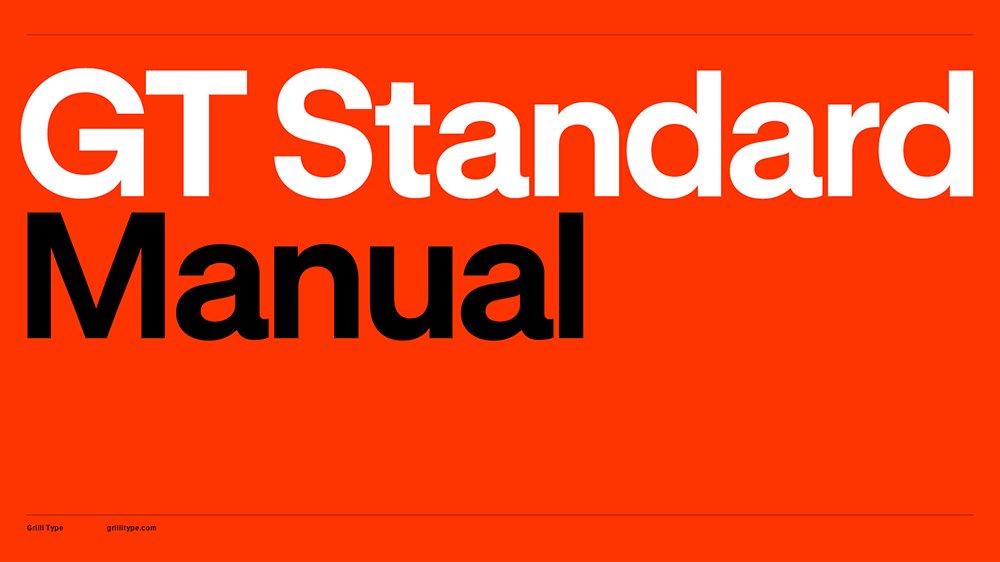
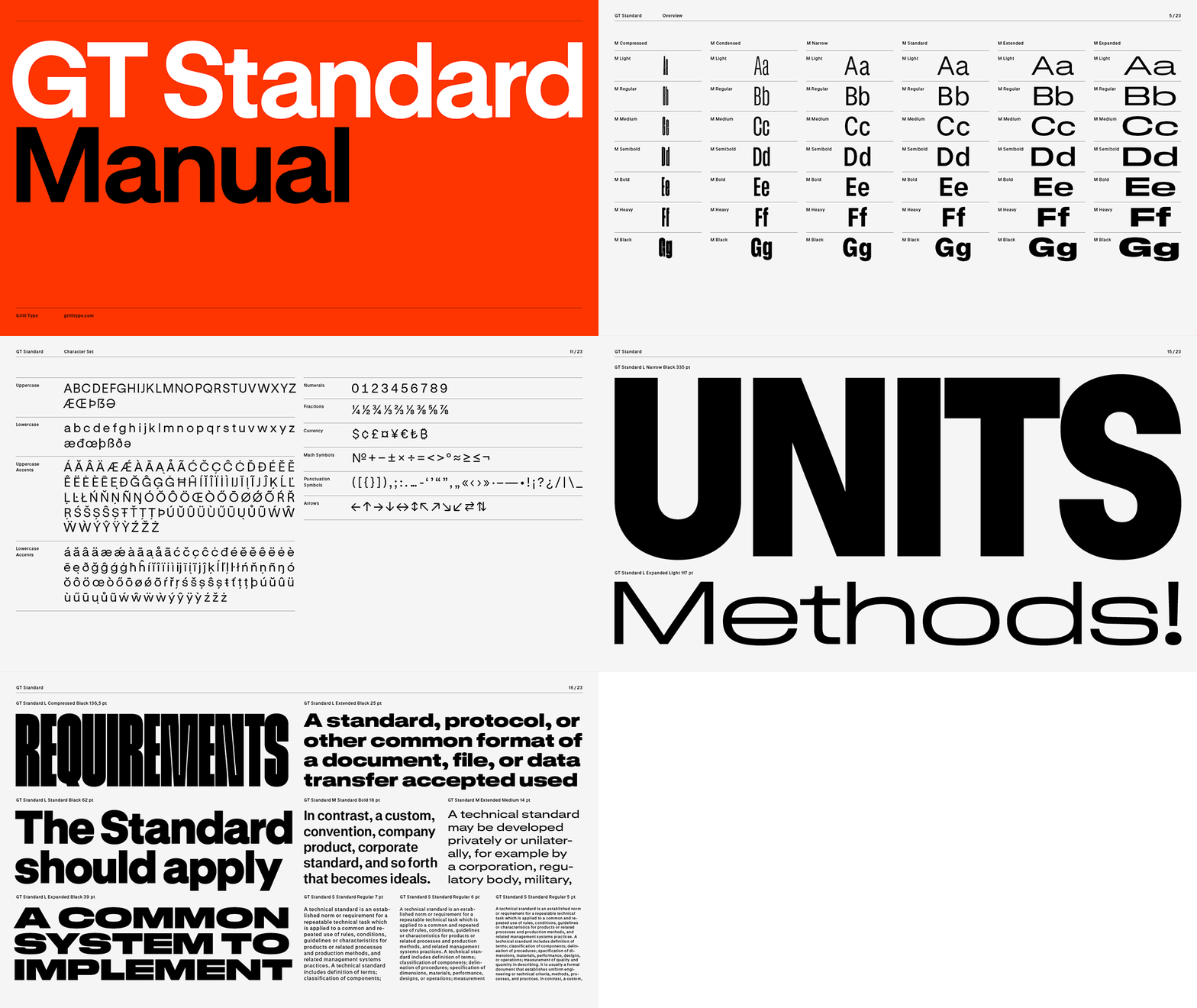
GT Standard is a contemporary response to the modernist pursuit of standardization. It’s rooted in the principles of Swiss Style and expands on this legacy to meet the needs of today’s visual landscape. The typeface is systematic yet expressive, built for clarity, adaptability, and precision across every scale and medium.
- Designed by Grilli Type
- Released in 2025
- Available in 336 styles
- GT Standard is available for customization and language extensions
- Download the free trial fonts
Typeface features
OpenType features enable smart typography. You can use these features in most Desktop applications, on the web, and in your mobile apps. Each typeface contains different features. Below are the most important features included in GT Standard’s fonts:
- SS01
- Alternate a
Regards
- SS02
- Alternate g
Engaging
- SS03
- Alternate y
Energy
- SS04
- Alternate Q
Quality
- SS06
- Rectangular Dots
Minimalism
- SS07
- Account Spoofing
Informal
Typeface Minisite
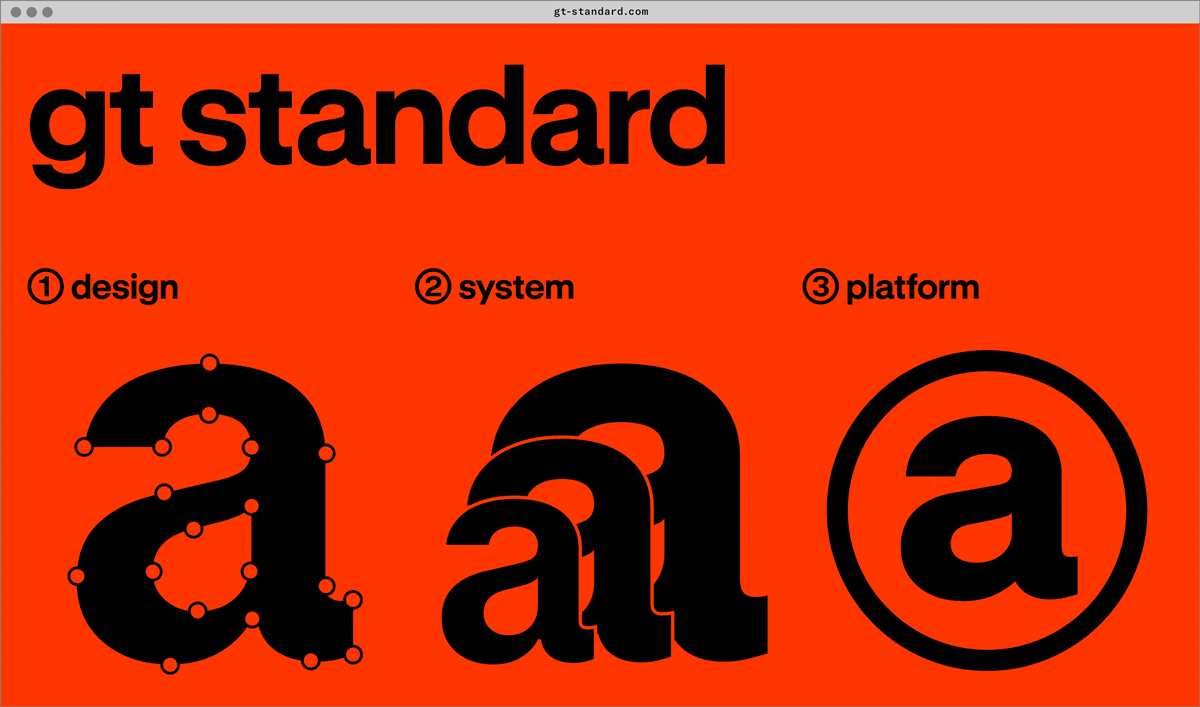
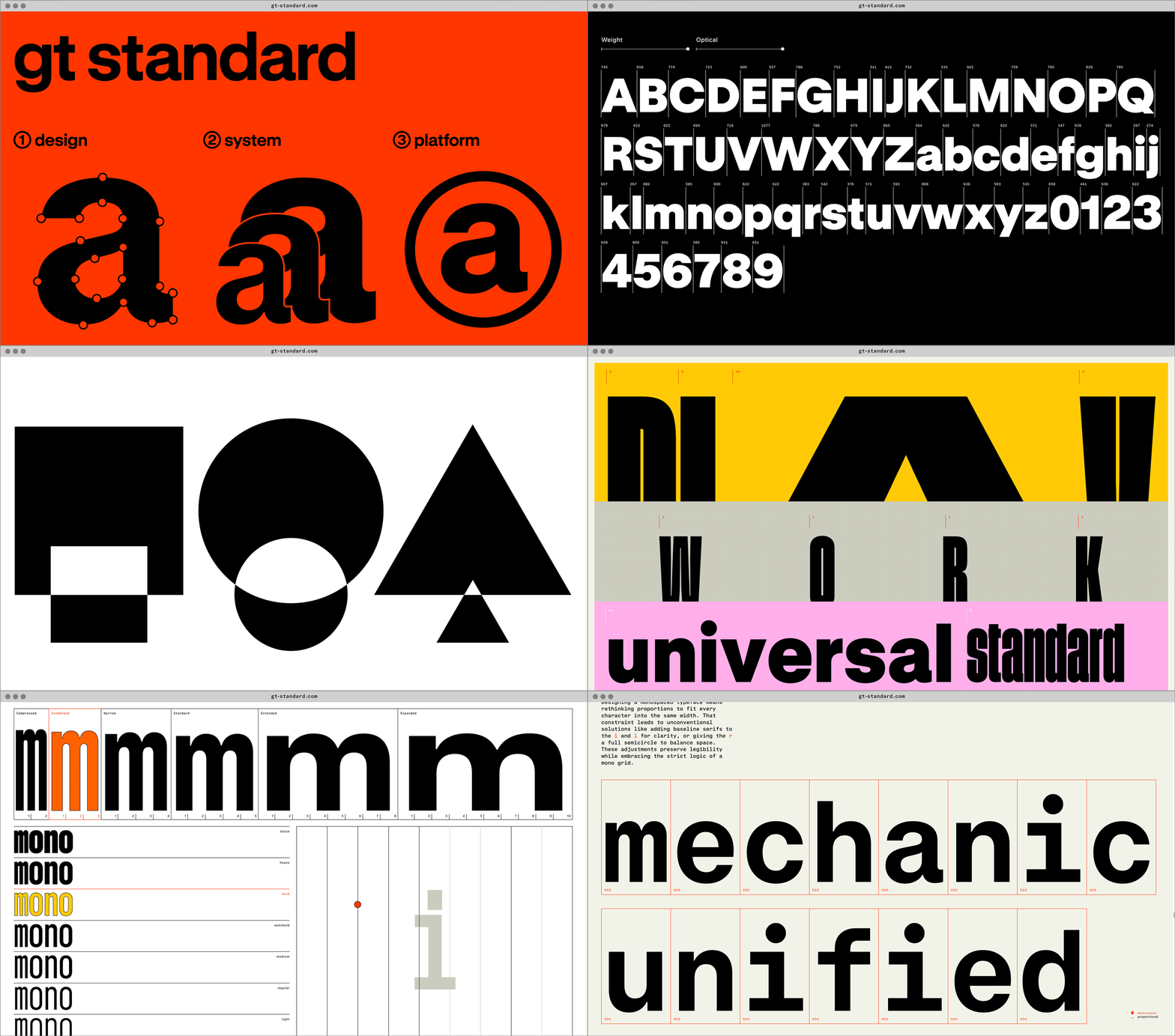
- Visit the GT Standard minisite to discover more about the typeface family’s history and design concept.
GT Standard in use