GT Canon

Family overview
- Condensed
- S Light Italic
- M Light Italic
- L Light Italic
- S Regular Italic
- M Regular Italic
- L Regular Italic
- S Medium Italic
- M Medium Italic
- L Medium Italic
- S Semibold Italic
- M Semibold Italic
- L Semibold Italic
- S Bold Italic
- M Bold Italic
- L Bold Italic
- S Heavy Italic
- M Heavy Italic
- L Heavy Italic
- S Black Italic
- M Black Italic
- L Black Italic
- Narrow
- S Light Italic
- M Light Italic
- L Light Italic
- S Regular Italic
- M Regular Italic
- L Regular Italic
- S Medium Italic
- M Medium Italic
- L Medium Italic
- S Semibold Italic
- M Semibold Italic
- L Semibold Italic
- S Bold Italic
- M Bold Italic
- L Bold Italic
- S Heavy Italic
- M Heavy Italic
- L Heavy Italic
- S Black Italic
- M Black Italic
- L Black Italic
- Standard
- S Light Italic
- M Light Italic
- L Light Italic
- S Regular Italic
- M Regular Italic
- L Regular Italic
- S Medium Italic
- M Medium Italic
- L Medium Italic
- S Semibold Italic
- M Semibold Italic
- L Semibold Italic
- S Bold Italic
- M Bold Italic
- L Bold Italic
- S Heavy Italic
- M Heavy Italic
- L Heavy Italic
- S Black Italic
- M Black Italic
- L Black Italic
- Extended
- S Light Italic
- M Light Italic
- L Light Italic
- S Regular Italic
- M Regular Italic
- L Regular Italic
- S Medium Italic
- M Medium Italic
- L Medium Italic
- S Semibold Italic
- M Semibold Italic
- L Semibold Italic
- S Bold Italic
- M Bold Italic
- L Bold Italic
- S Heavy Italic
- M Heavy Italic
- L Heavy Italic
- S Black Italic
- M Black Italic
- L Black Italic
- Expanded
- Mono
- Light Italic
- Regular Italic
- Medium Italic
- Semibold Italic
- Bold Italic
- Heavy Italic
- Black Italic
Subfamilies
- Standard S LightContrast is difference made visible, the consequence and prerequisite of an appearance. Without contrast, there is no difference. Everything is not just monotonous, it simply is not. It is one and therefore isn’t. Contrast is the distance and proximity of the in-between. What is, is through difference.
- Standard M LightThe scene is laid in the house of Cephalus at the Piraeus; and the whole dialogue is narrated by Socrates the day after it actually took place to Timaeus, Hermocrates, Critias, and a nameless person, who are introduced in the Timaeus.
- Standard L LightAll we see are moments of division, are the edges where the one tips over into the other in order to remain the same. In praise of imagery: Imagination, pencils and all other instruments of visualisation eventually help us to create these compressed surfaces.
- Standard S Light ItalicScaling therefore entails rounding operations and antialiasing strategies that alter the appearance of shapes, particularly at small sizes where a single pixel represents a significant portion of form. Software environments introduce further divergence, using distinct coordinate systems, unit definitions, and conversion routines.
- Standard M Light ItalicA face embodies character: the severity of a brutalist façade, the lightness of thin display cut, the friendliness of rounded terminals. The face is also about recognition: we know a style by its face, we choose an object because of the impression it projects.
- Standard L Light ItalicDepends on a ruler who can be deceived, attacked, and overthrown. Higher power unfolds beyond that. Smart, gentle, even “positive” power operates through consent, self-optimisation, and internalisation, not through prohibition or force.
- Standard S RegularIt is too simplistic to equate the broadening of the denominator with an expansion of the numerator. Yet, there lies a sever misconception and danger in this term. Not so much because the dividing lines between users and manufacturers are supposedly becoming increasingly blurred in the rapidly changing digital landscape, but rather because of an ontological misconception in believing that the acting subject knows not just the rational and motives behind it’s actions, but also knows itself, and considers the urge of knowing itself as a invisible but leading design principle.
- Standard M RegularOn a page, balance occurs across the line: x-height against ascender height, text weight against leading, headline mass against white space. In multi-weight families, balance becomes structural.
- Standard L RegularThe original or merely a template? Traces? And who is to say that our sense of things, our emotions and feelings, are nothing but an unwitting attempt to quote the stories and songs that have moved us?
- Standard S Regular ItalicIf my limited knowledge of physics, gained from school lessons long time ago, has enabled me to understand the theorists of general relativity correctly, the motion of our planets around the sun is only apparently circular, but rather a kind of straight line.
- Standard M Regular ItalicHow does a bold relate to its regular? How does balance persist across axes? Balance champions accuracy over precision. It is about what we see, not what we measure. And the eye likes balance, not boredom. Balance is invitation.
- Standard L Regular ItalicWe live in the age of scale. In economic ventures, scalability has long been the guiding principle on which new enterprises are founded; whoever masters the challenges of scaling is promised success. More interesting, however, are the observations that can be made across disciplines whenever something is scaled.
- Standard S MediumHe looked out the window at the Hudson River, ruddied in the flame of the dying sun, and wondered moodily whether these last experiments would finally bring him the fame and success he was after, or if they were merely some more false alarms.
- Standard M MediumThe way biological systems (cells, organs, ecosystems) shift their dynamics as they grow. The contrast between quantum behaviour and classical mechanics. In digital graphics, the notion of scalability is commonly treated as resolved: vector graphics are assumed to be infinitely and losslessly scalable.
- Standard L MediumWhat are the consequences? On the one hand, the design of the self. The device-ification of our bodies does not begin with chip implants, artificial intelligence and the semi-automation of intellectual work, but earlier and more decisively through this very intertwining of design and the various modes of supposed self-discovery.
- Standard S Medium ItalicTension as a whole does not arise from the unrestrained or untamed wildness of individual elements. On the contrary, it is the right balance of unity and discipline on the one hand, and deviation on the other. In political and social contexts, the dissolution of tension is a noble and worthy pursuit. In design, it all too often leads to illegibility. This applies in both directions. After all, what is attraction, what is eroticism? The casual display of the fully revealed whole, or the play of gradually unveiling its parts? No tension, no relation.
- Standard M Medium ItalicAlthough we could describe text, in contrast to images, as a medium of lines (and here the line becomes a demarcation line on all significative levels), it is images—or more precisely, the pictorial nature of the visual—that, alongside the virtual, mathematical construct, allows for manifestation of lines in the first place.
- Standard L Medium ItalicWhen quoting, words do not necessarily have to change, and yet most things do alter. Typeface, layout, screen, print technology, paper, context, means of distribution. Quoting always raises the question of origin and our relationship to it. What is it that we change when we quote?
- Standard S SemiboldEvery face is different, and every face is the same: it reveals not only itself, but the generality of its essence. Hence, every face is both singular and plural: this face, and the category of face. To call something a face is to give it agency, to acknowledge that it meets us.
- Standard M SemiboldEdges mark the threshold of meaning, the moment when sense meets its outside of the inside of the outside of the sentence. And therefore all is exterior.
- Standard L SemiboldDepends on a ruler who can be deceived, attacked, and overthrown. Higher power unfolds beyond that. Smart, gentle, even “positive” power operates through consent, self-optimisation, and internalisation, not through prohibition or force.
- Standard S Semibold ItalicIt does not matter what note you play. What only matters is which note follows, a legendary trumpet player once said (in a pretty different way, but that is how I remember the quote).
- Standard M Semibold ItalicConsidering that the little party had been seated round the tea-table for less than twenty minutes, the animation observable on their faces, and the amount of sound they were producing collectively, were very creditable to the hostess.
- Standard L Semibold ItalicOn a page, balance occurs across the line: x-height against ascender height, text weight against leading, headline mass against white space. In multi-weight families, balance becomes structural.
- Standard S BoldNo doubt the feat was easy to Mr. Utterson; for he was undemonstrative at the best, and even his friendship seemed to be founded in a similar catholicity of good-nature. It is the mark of a modest man to accept his friendly circle ready-made from the hands of opportunity; and that was the lawyer’s way.
- Standard M BoldWhat are we but areas that move between areas, perceiving areas, dividing areas, with the help of areas, into more areas? Lines, on the other hand, lead a ghostly existence: in their terrible conspicuousness, they are omnipresent and yet we cannot perceive them.
- Standard L BoldAccordingly, texts are often described as linear, even though, in most cases, this linearity is erratic or even fractal (with eye movements consisting of saccades). Any attempts to escape this linearity usually result in the lines becoming fragmented into more lines, except in the case of one-word readers, where the reading movement is directed towards a single word.
- Standard S Bold ItalicBalance is the tension needed to neither explode or implode. What arises when intention meets the accidental and neither is abolished. In bodies, in breaths, in the temporality and modalities of being, balance appears as that which is always about to shift.
- Standard M Bold ItalicDisplay denotes a style made for large sizes: headlines, titles, posters. Display styles often stress features: thinner hairlines, sharper serifs, higher contrast, narrower spacing. They prioritise impact over long, continuous readability.
- Standard L Bold ItalicSince design means composing contrasts, creating tension can be a consequence. It’s not inevitable though. Contrast is no guarantee that tension will emerge. Quite the opposite. Tension is a rare commodity. Too much,and it dissipates. Often, the sweet spot lies in drawing the bow just far enough that it does not break.
- Standard S HeavyBroadly speaking, anatomy refers to the internal architecture of organisms, i.e. how bones, muscles, vessels, nerves and organs are arranged and how they relate to each other to form a functional whole.
- Standard M HeavyWho is the user of a typeface? The graphic designer, typographer and reader? Or is it equally down to its designer? UX-driven objectives still play a major role in type design, which is being framed in terms of legibility, usability, screen optimisation, hinting, or responsive typography.
- Standard L HeavyJustification is a responsive act, regardless of whether what is to be justified lies in the past or in the future, as any justification presupposes something that has gone before. If that something points forwards, its intention is at least roughly outlined (by virtue of its potential to be realised).
- Standard S Heavy ItalicContrast is difference made visible, the consequence and prerequisite of an appearance. Without contrast, there is no difference. Everything is not just monotonous, it simply is not. It is one and therefore isn’t. Contrast is the distance and proximity of the in-between. What is, is through difference.
- Standard M Heavy ItalicDepends on a ruler who can be deceived, attacked, and overthrown. Higher power unfolds beyond that. Smart, gentle, even “positive” power operates through consent, self-optimisation, and internalisation, not through prohibition or force.
- Standard L Heavy ItalicIn recent years, few terms in design have enjoyed such a meteoric rise as the two letters U and X. User experience quickly became the measure of all things. At first glance, there seems to be little wrong with that. Anyone who strives to offer users the best possible experience does not have to be a showman or a charlatan who turns even the simplest interaction into an experience.
- Standard S BlackThere is something in the foot of the horse that has been a mystery to many who have been unable to find out the secrets by reading some of the books that have been printed on the different subjects, and experimenting on the same, pertaining to a perfect balance of the trotter and pacer when in action.
- Standard M BlackOn a page, balance occurs across the line: x-height against ascender height, text weight against leading, headline mass against white space. In multi-weight families, balance becomes structural.
- Standard L BlackDesign is always an act of presumption. I do not design from the position that I am entitled to. I am not a chair. Horses have never painted humans on a wall. It is a common misconception that the means of design must reflect—or even find their equivalent in—the social and biographical conditions of their production.
- Standard S Black ItalicThe original or merely a template? Traces? And who is to say that our sense of things, our emotions and feelings, are nothing but an unwitting attempt to quote the stories and songs that have moved us?
- Standard M Black ItalicContrast is difference made visible, the consequence and prerequisite of an appearance. Without contrast, there is no difference. Everything is not just monotonous, it simply is not. It is one and therefore isn’t. Contrast is the distance and proximity of the in-between. What is, is through difference.
- Standard L Black ItalicA weight here presupposes a counter there, even if that counter is nothing but the absence of its here with reversed signs. Balance does not eliminate difference; it activates it, arranges it, gives it place.
- Settings
Typeface information
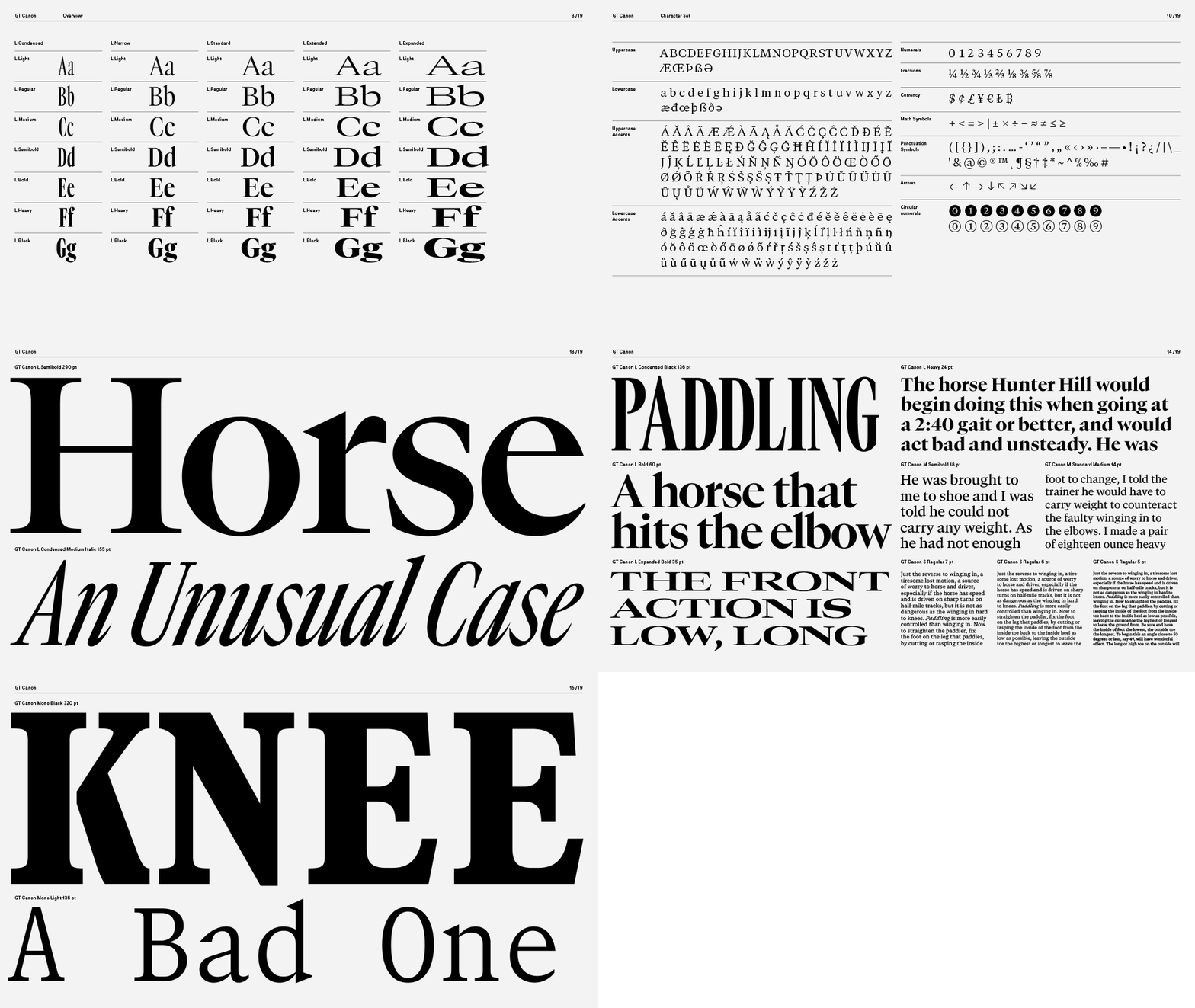
GT Canon’s design is pragmatic but not static: movement and liveliness are embedded in the letterforms. It is our answer to what our digital times require of a serif today. It’s what a contemporary serif should be in both form and function. Like its sans serif sibling, GT Standard, it aims for modern functionality rather than stylistic reinvention.
- Designed by Grilli Type
- Released in 2026
- Available in 224 styles
- GT Canon is available for customization and language extensions
- Download the free trial fonts
Typeface features
OpenType features enable smart typography. You can use these features in most Desktop applications, on the web, and in your mobile apps. Each typeface contains different features. Below are the most important features included in GT Canon’s fonts:
- TNUM
- Tabular figures
0123456789
- ONUM
- Oldstyle figures
0123456789
- SMCP
- Small Caps
Anatomy
Typeface Minisite
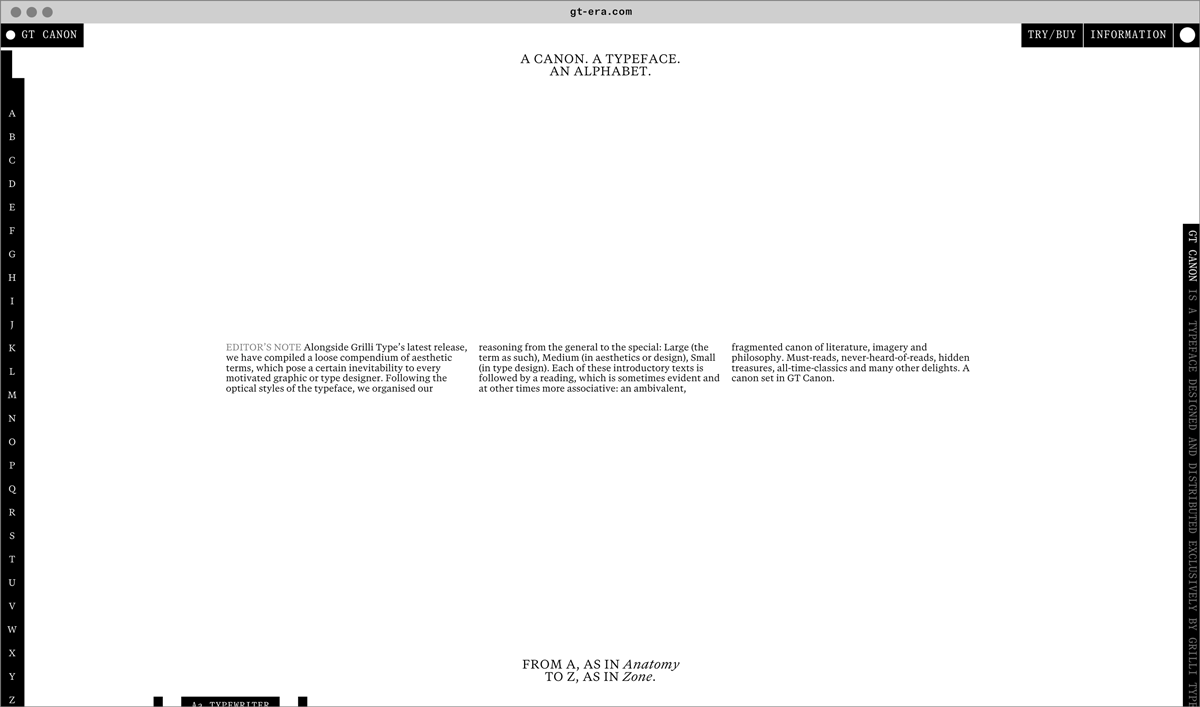
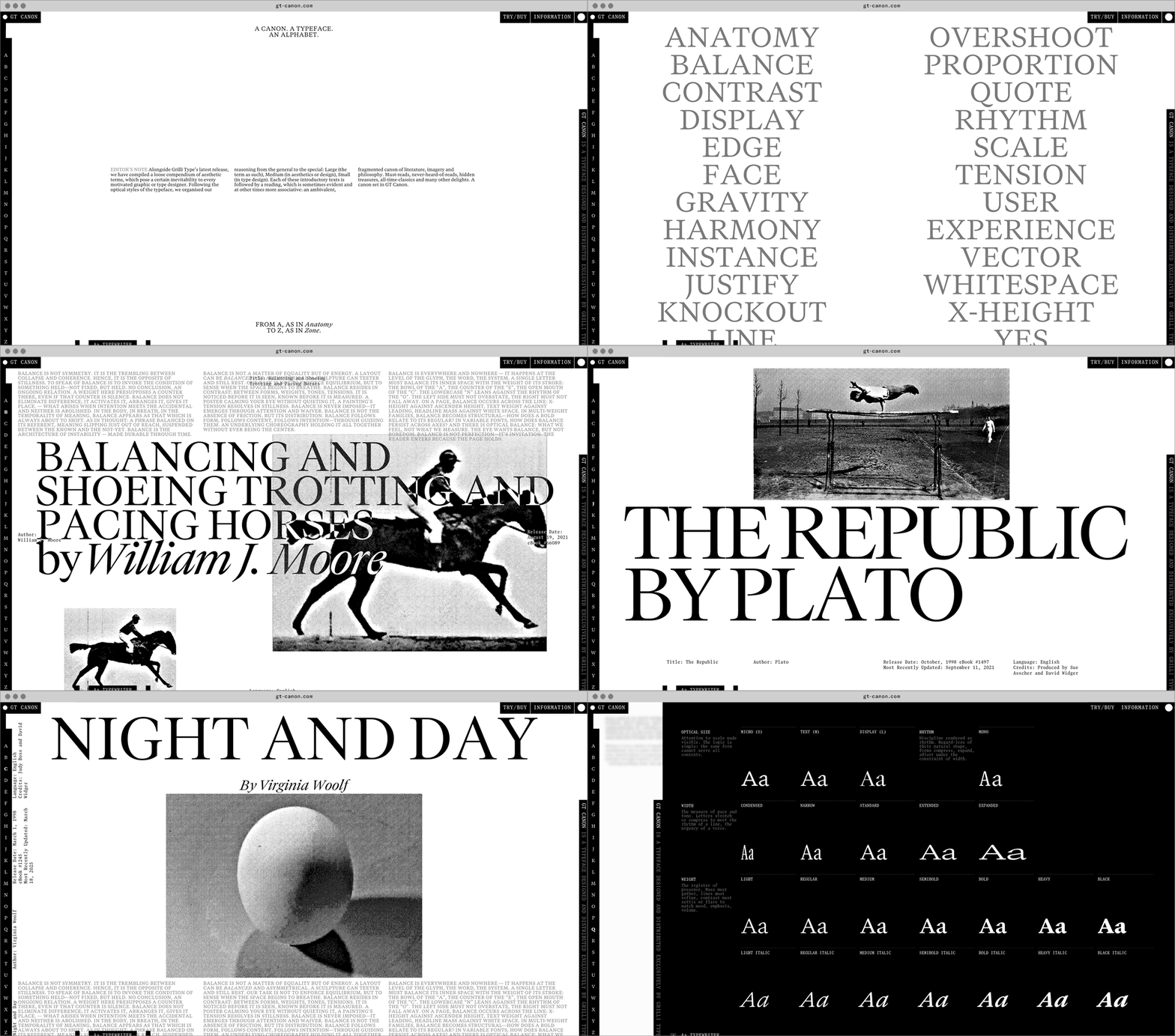
- Visit the GT Canon minisite to discover more about the typeface family’s history and design concept.
GT Canon in use