GT Eesti

Family overview
- Text
- Ultra Light Italic
- Thin Italic
- Light Italic
- Book Italic
- Regular Italic
- Medium Italic
- Bold Italic
- Display
- Ultra Light Italic
- Thin Italic
- Light Italic
- Regular Italic
- Medium Italic
- Bold Italic
- Ultra Bold Italic
Subfamilies
- Text Ultra LightТюри город без муниципального статуса в центре Эстонии в уезде Ярвамаа, является волостным центром и составной частью волости Тюри. Расположен на реке Пярну. Железнодорожная станция на линии Таллинн — Вильянди. Имеется храм Святой Троицы (Эстонская православная церковь Московского Патриархата).
- Text Ultra Light ItalicПылтсамаа город в центральной части Эстонии в уезде Йыгевамаа. Расположен на реке Пылтсамаа. Является самостоятельным городским муниципалитетом и не входит в состав какой-либо волости.
- Text ThinSindi (German: Zintenhof) is a town in Pärnu County, Estonia, with a population of 4,076 in 2013. It is located 14 kilometers from the county capital Pärnu, on the left coast of the Pärnu River.
- Text Thin ItalicTüri on vallasisene linn Türi vallas Järva maakonnas. Asub Pärnu jõe ääres. Türit läbib Tallinna–Viljandi raudteeliin ja Pärnu–Rakvere–Sõmeru maantee.
- Text LightSaue on linn Harju maakonnas Tallinnast 4–5 kilomeetrit edela pool. Territoriaalselt on see “enklaav” Saue valla sees, kuid kagupiiril eraldab teda lähinaabrist Saku vallast vaid Tallinna–Pärnu kaherealise maantee laiune riba.
- Text Light ItalicTüri on vallasisene linn Türi vallas Järva maakonnas. Asub Pärnu jõe ääres. Türit läbib Tallinna–Viljandi raudteeliin ja Pärnu–Rakvere–Sõmeru maantee.
- Text BookКохтла-Ярве город на северо-востоке Эстонии. Расположен на залежах горючего сланца, добыча и переработка которого являются основными видами деятельности в городе.
- Text Book ItalicSindi (German: Zintenhof) is a town in Pärnu County, Estonia, with a population of 4,076 in 2013. It is located 14 kilometers from the county capital Pärnu, on the left coast of the Pärnu River.
- Text RegularTapa is a town in Lääne-Viru County, Estonia. Located at the junction of the country’s Tallinn–Narva (west–east) and Tallinn–Tartu–Valga (north–south) railway lines.
- Text Regular ItalicTüri on vallasisene linn Türi vallas Järva maakonnas. Asub Pärnu jõe ääres. Türit läbib Tallinna–Viljandi raudteeliin ja Pärnu–Rakvere–Sõmeru maantee.
- Text MediumNarva on linn Eesti kirdeosas Ida-Viru maakonnas Narva jõe alamjooksul. Narva on suuruselt Eesti kolmas linn Tallinna ja Tartu järel ning suurem kui 50 km kaugusel asuv maakonnakeskus Jõhvi. Ta on Eesti linnadest idapoolseim.
- Text Medium ItalicНарва третий по численности населения город Эстонии, преимущественно русскоязычный, самый крупный город уезда Ида-Вирумаа.
- Text BoldKehra on vallasisene linn Anija vallas Harjumaal Jägala jõe ääres, Tallinnast idas. 1945 sai ta iseseisva omavalitsusega alevi staatuse, 1993.
- Text Bold ItalicSindi on linn Pärnu maakonnas Pärnu jõe vasakul kaldal jõe ning Lanksaare raba vahelisel tasandikul 14 km kaugusel Pärnust. Sindi linnapea on Marko Šorin.
- Settings
Typeface information
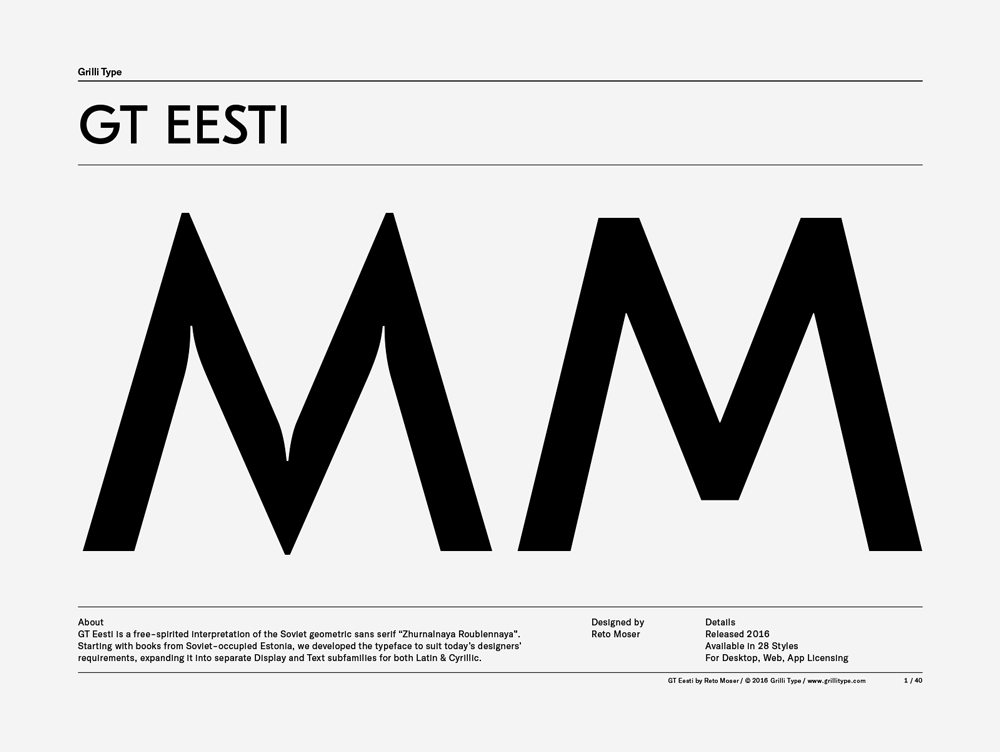
GT Eesti is a free-spirited interpretation of the Soviet geometric sans serif “Zhurnalnaya Roublennaya”. Starting with books from Soviet-occupied Estonia, we developed the typeface to suit today’s designers’ requirements, expanding it into separate Display and Text subfamilies for both Latin & Cyrillic.
- Designed by Reto Moser
- Released in 2016
- Available in 28 styles
- GT Eesti is available for customization and language extensions
- Download the free trial fonts
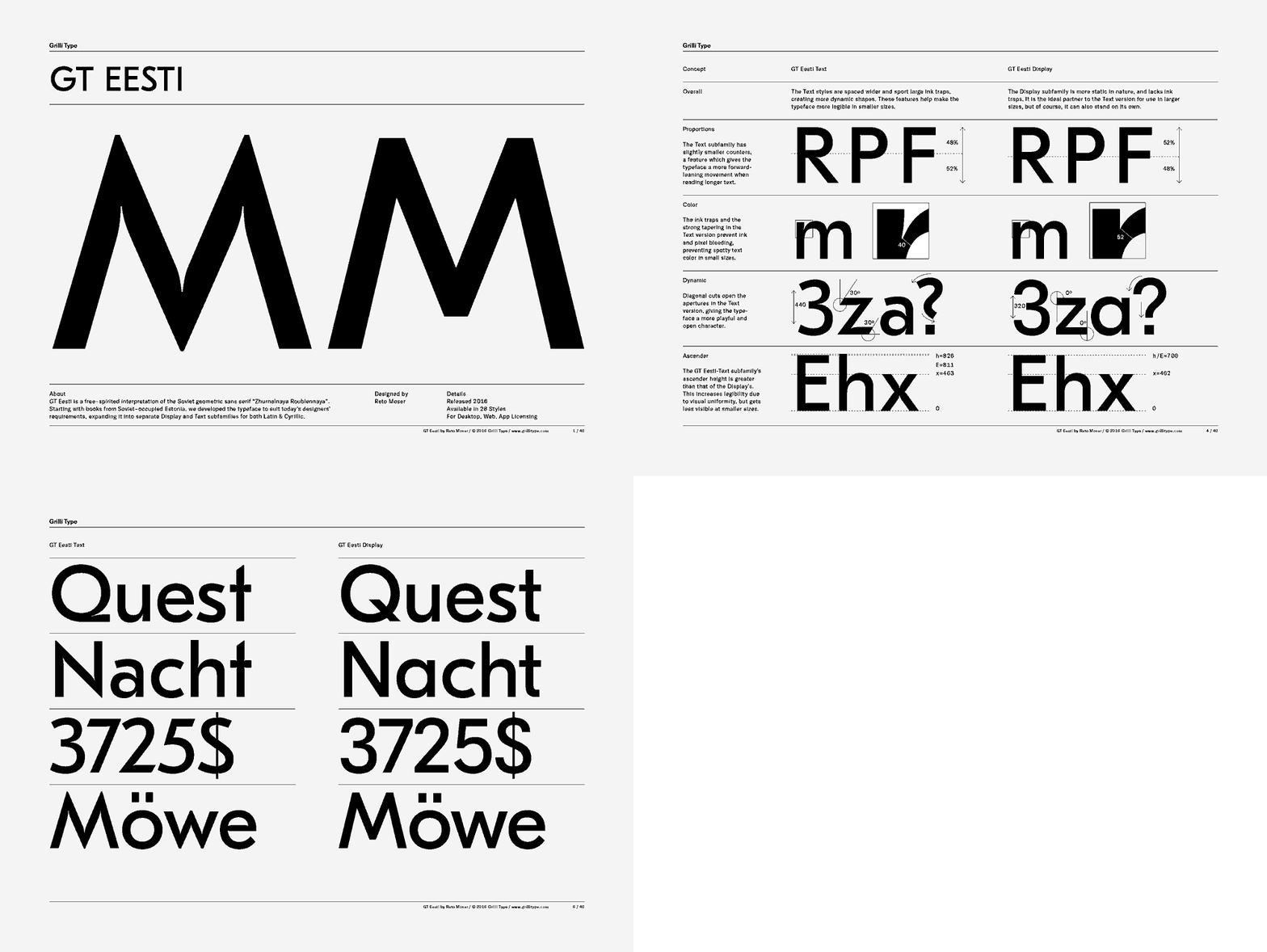
Typeface features
OpenType features enable smart typography. You can use these features in most Desktop applications, on the web, and in your mobile apps. Each typeface contains different features. Below are the most important features included in GT Eesti’s fonts:
- SS01
- Circular dots
Österreich?!
- SS02
- Compact accents
RÜCKWÄRTS
- SS03
- Historical “ß”
Weisestraße
- SS04
- Alternate “w” and “v”
- (Text version only)
Privatweg
Typeface Minisite
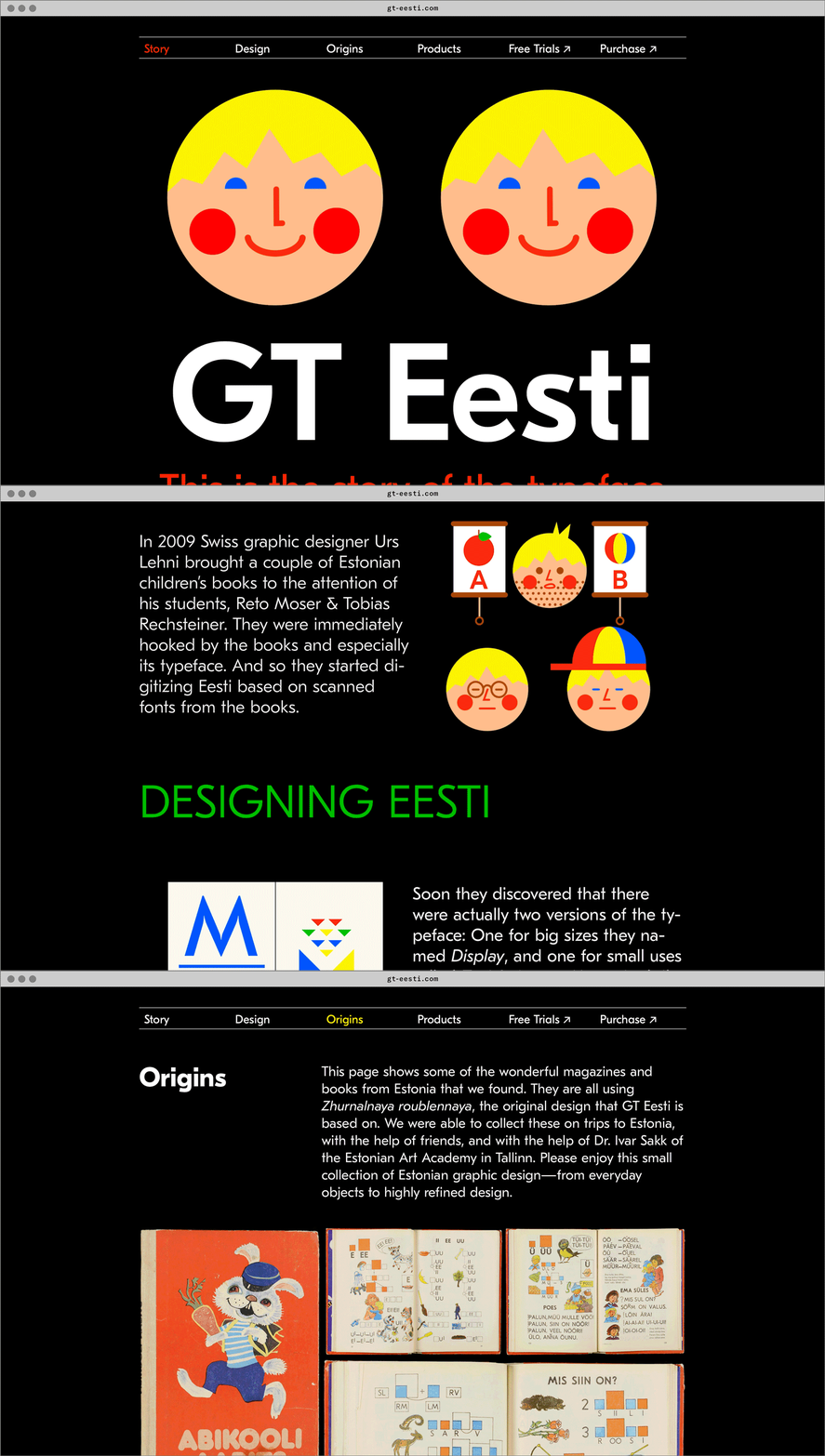
- Visit the GT Eesti minisite to discover more about the typeface family’s history and design concept.
GT Eesti in use