GT Mechanik

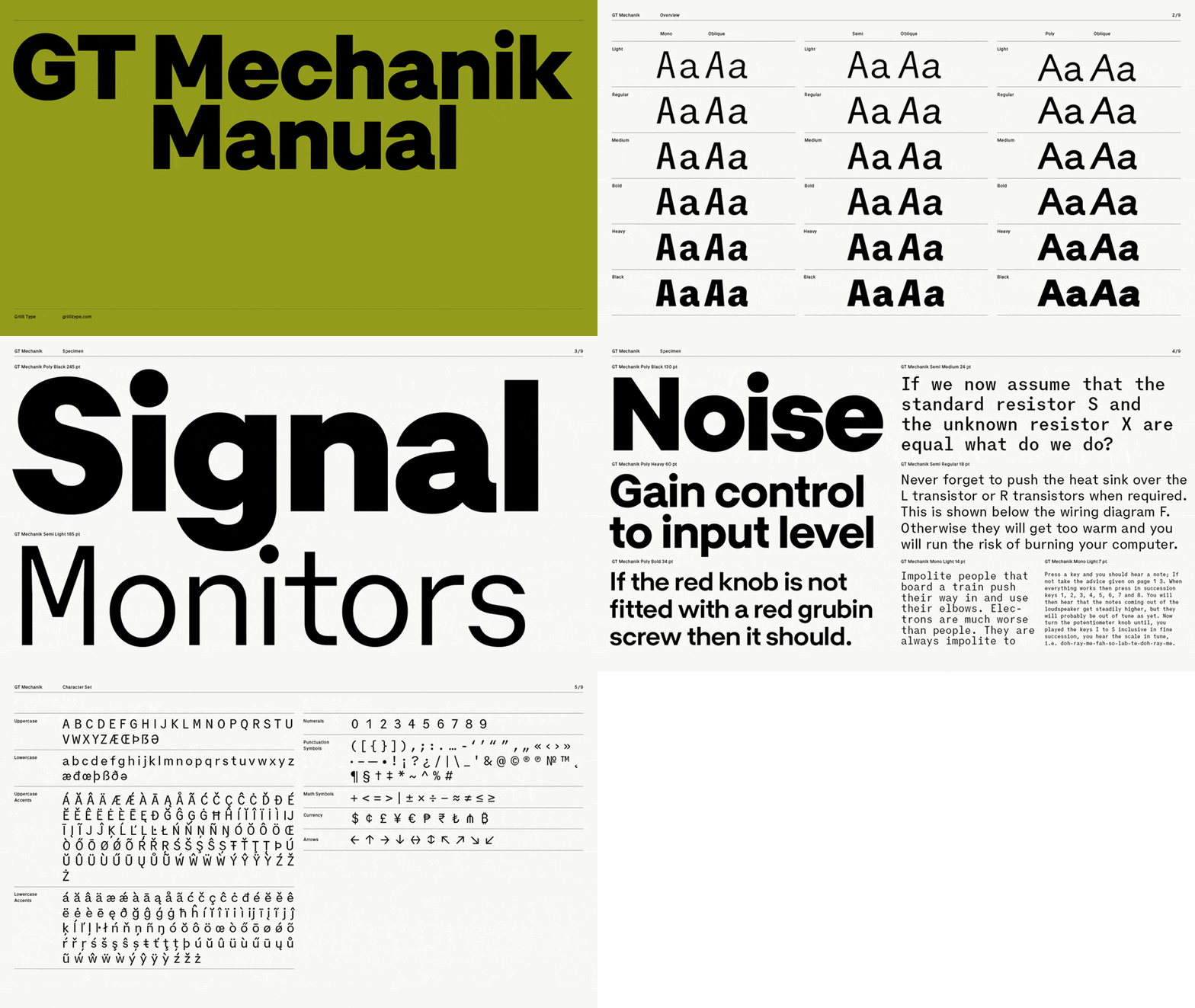
Family overview
- Mono
- Thin Oblique
- Light Oblique
- Regular Oblique
- Medium Oblique
- Bold Oblique
- Heavy Oblique
- Black Oblique
- Semi
- Thin Oblique
- Light Oblique
- Regular Oblique
- Medium Oblique
- Bold Oblique
- Heavy Oblique
- Black Oblique
- Poly
- Thin Oblique
- Light Oblique
- Regular Oblique
- Medium Oblique
- Bold Oblique
- Heavy Oblique
- Black Oblique
Subfamilies
- Semi ThinAt 088 units on the scale, deviation becomes visible while remaining within tolerance, indicating measurable difference without exceeding the operational limits that define system stability.
- Semi Thin ObliqueWaveform rendering time as visible form by tracing variation across an axis, allowing duration to be interpreted spatially and making pattern recognition possible through the continuity of its structure.
- Semi LightInterference arises when overlapping signals disrupt each other’s structure, producing composite patterns that resist stable interpretation while still carrying traces of their original forms.
- Semi Light ObliqueOur gain setting at +6 dB increases signal magnitude relative to a reference level, enhancing presence while maintaining proportional structure within the system.
- Semi RegularA 10–20–34 TONE sequence encodes information through ordered intervals, allowing meaning to emerge from relational differences rather than isolated values within the sequence.
- Semi Regular ObliqueWaveform rendering time as visible form by tracing variation across an axis, allowing duration to be interpreted spatially and making pattern recognition possible through the continuity of its structure.
- Semi MediumA measurement expresses the relation between a system and its reference, translating variation into comparable values that reflect calibrated agreement rather than absolute precision or fixed truth.
- Semi Medium ObliqueCalibration at 1 kHz establishes a reference point against which variation can be detected and measured, allowing the system to maintain consistency across readings while accommodating minor deviations within a controlled tolerance.
- Semi BoldA reference point anchors variation within a system, making differences comparable by establishing a consistent baseline against which all deviation can be measured and understood.
- Semi Bold ObliqueThe signal collapses variation into a single channel, reducing spatial differentiation while preserving continuity of content within a simplified transmission structure.
- Semi HeavyCHANNEL 33 designates a specific position within a spectrum, organizing activity by location rather than content within a shared range that structures access and distribution.
- Semi Heavy ObliqueCHANNEL 33 designates a specific position within a spectrum, organizing activity by location rather than content within a shared range that structures access and distribution.
- Semi BlackAt 088 units on the scale, deviation becomes visible while remaining within tolerance, indicating measurable difference without exceeding the operational limits that define system stability.
- Semi Black ObliqueBecause 75 OHM impedance match aligns components within a transmission path to minimize reflection, ensuring continuity of signal across boundaries where mismatched conditions would otherwise produce loss.
- Settings
Typeface information
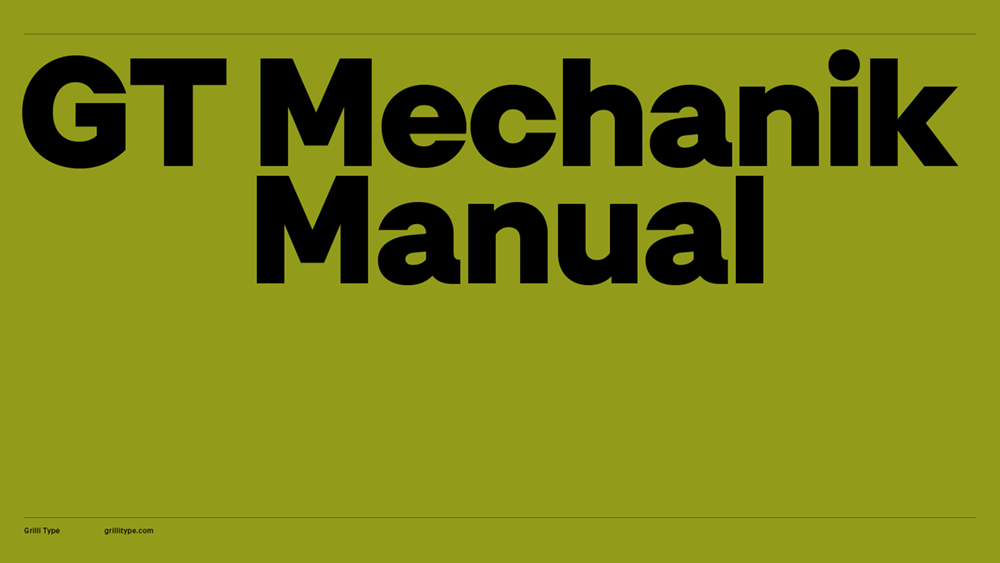
GT Mechanik dials in the appeal of electromechanical text systems by building an inevitable family around its monospace style. Idiosyncratic features that come with the restraints of mechanic typesetting become guiding principles along the tone axis. Mono, Text and Display, each follow that logic at a different scale and intensity.
- Designed by Shiva Nallaperumal, Reto Moser, Noël Leu
- Released in 2026
- Available in 42 styles
- GT Mechanik is available for customization and language extensions
- Download the free trial fonts
Typeface features
OpenType features enable smart typography. You can use these features in most Desktop applications, on the web, and in your mobile apps. Each typeface contains different features. Below are the most important features included in GT Mechanik’s fonts:
- TNUM
- Tabular figures
0123456789
Typeface Minisite
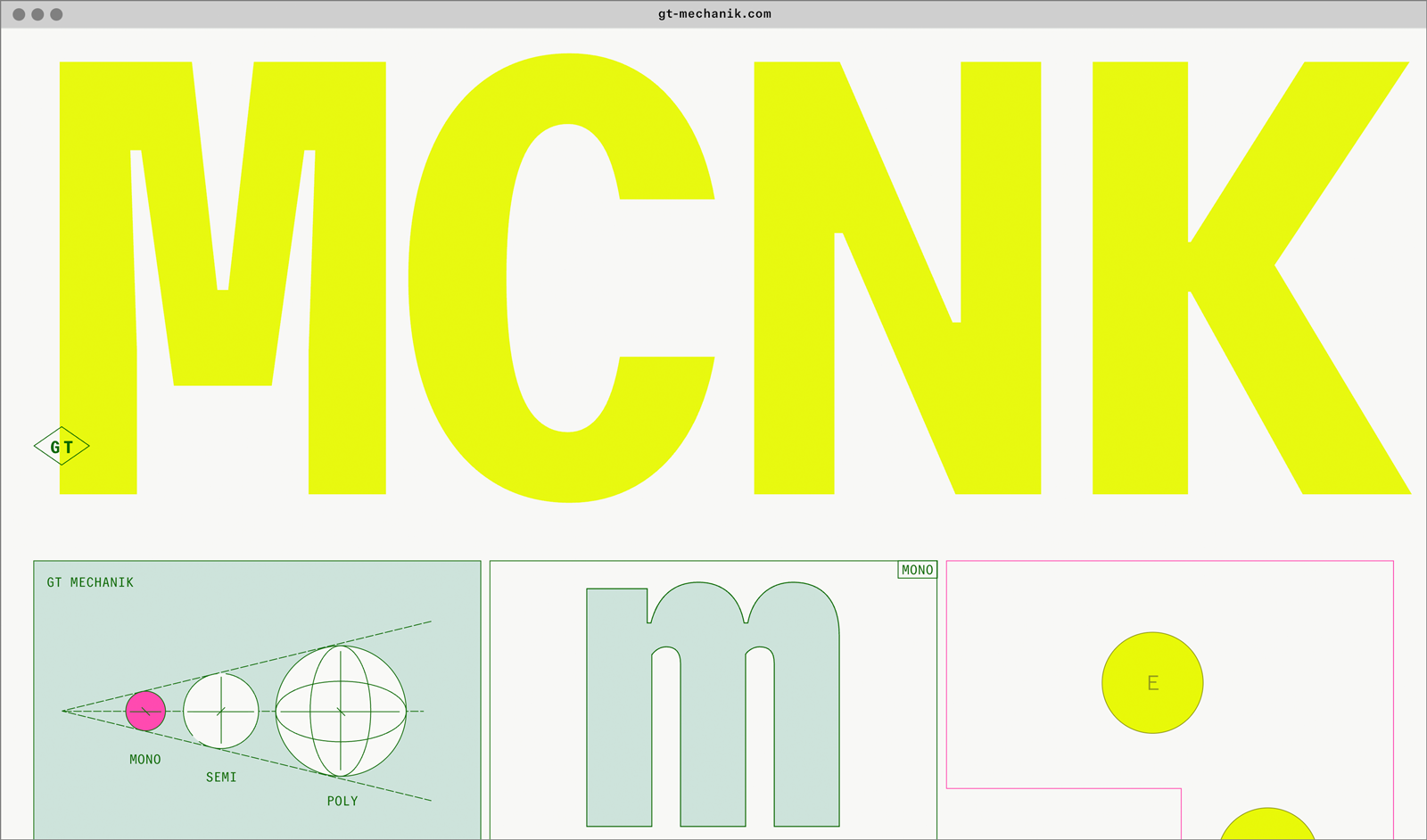
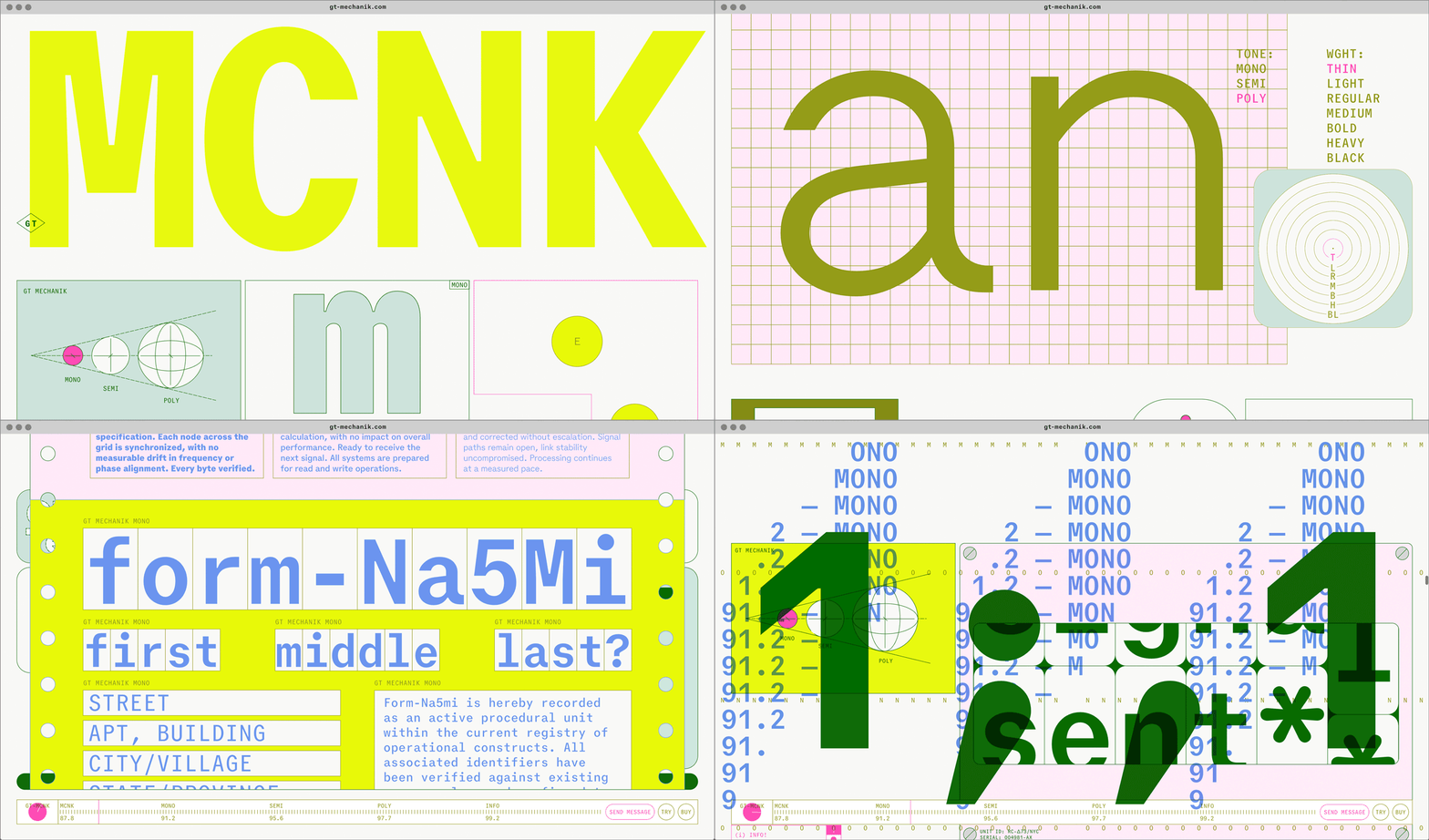
- Visit the GT Mechanik minisite to discover more about the typeface family’s history and design concept.